
AI is starting to appear in HR job titles, but it is still rare in HR job postings, and the shift from using AI tools to building with them has only just begun. That is what the sources support, and they support it in a more cautious form than most commentary.
Many HR teams now use AI in some form. Far fewer employ people whose job is to build and run it. This article looks at what Gartner forecasts, what job-posting data shows, what a builder role looks like in practice and what HR leaders can do about it.

From using AI to building with it
Gartner forecasts that about half of today’s HR activities will be autoAI is starting to appear in HR job titles, but it is still rare in HR job postings, and the shift from using AI tools to building with them has only just begun. That is what the sources support, and they support it in a more cautious form than most commentary.
Many HR teams now use AI in some form. Far fewer employ people whose job is to build and run it. This article looks at what Gartner forecasts, what job-posting data shows, what a builder role looks like in practice and what HR leaders can do about it.
mated or done by AI agents by 2030, but it words the claim three different ways and publishes no method. Its HR transformation page says “could” and “may”, and its operating-model article says “will”. The same sentence appears in an HR Dive opinion piece by two Gartner HR analysts from 2 March 2026. We treat it as a vendor forecast, not a measurement.
The more useful Gartner point is about organisation, not technology. The operating-model article says AI success “depends only 30% on the technology itself and 70% on how effectively organizations redesign HR processes”, again without a stated method. It describes an HR innovation team that reports to the CHRO and works with IT on the AI agenda.
On adoption, Gartner’s figures are broad. The operating-model article cites AI adoption reaching 95% of CHROs by the end of 2025, and the HR Dive piece cites 92% of HR leaders saying their function has acted on AI in the last six months. Neither gives a sample or dates, and neither separates chat use from building, so they show interest, not capability.
What the job market shows
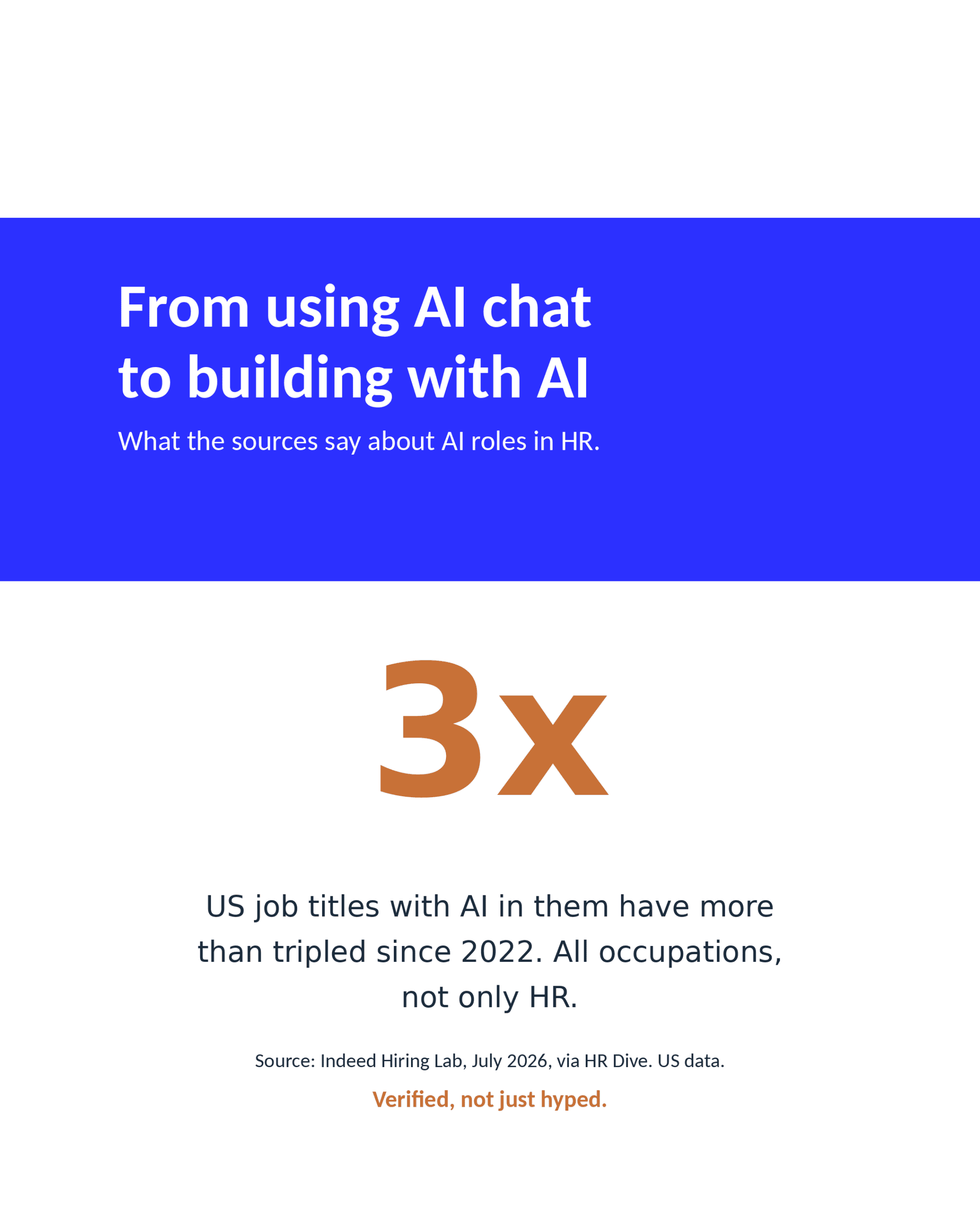
AI is spreading into job titles across the economy, but only a small share of HR postings ask for it. Indeed Hiring Lab found that the number of job titles with AI in them has more than tripled in the US since 2022, and that 63% of US AI-touched titles are outside tech (HR Dive, 13 July 2026). That covers all occupations, not only HR, and some of those roles have existed for decades under a new label.
For HR specifically, two US datasets point the same way. Lightcast data reported by HCA Magazine shows about 2% of HR postings requiring AI skills, with a 66% growth rate “as of 2024”, which is growth from a very small base. A SHRM report summarised by HR Dive found that 3.1% of HR postings mentioned AI, against 2.3% of the wider US market. A mention is not use, and neither source says how many roles actually build anything.
What a builder role looks like
A Labcorp posting from May 2026, since closed, shows the kind of role the trend points to. The Director, HR AI Technology Solutions would build and maintain an “agentic orchestration layer” across HR platforms, deploy AI applications for talent acquisition, people operations and workforce analytics, and monitor models for bias, accuracy and performance. The role leads a team of one to three developers.
An EY posting from April 2026, also closed, is a different thing. The Director, AI HR Reimagined redesigns HR operating models for clients, so it is a consulting role, not an in-house builder. Together the two show that AI in an HR job title can mean very different work.
We found no data on HR roles with AI in the title in Denmark or the rest of the Nordics, so this article makes no claim about them.
What HR leaders can do
The sources suggest four moves. Where a step is our inference, it says so.
- Decide the operating model first. Gartner’s 30/70 split argues that how HR redesigns its processes matters more than which tool it buys.
- Name who builds. The Labcorp posting shows one version: a leader who owns the AI layer across HR platforms and a small developer team. Whether that fits a given company is our inference.
- Write down the skills you need. Gartner’s analysts name AI literacy, responsible AI governance, intelligent workflow design and data engineering as skills to develop.
- Protect the human skills. The same analysts warn that too much technical upskilling can erode critical thinking, emotional intelligence and relationship management, which are hard to rebuild.
The Labcorp role also includes monitoring models for bias and accuracy. That is a useful test for any build role: who checks the output?
About the figures
As of 17 October 2026, every number here is a forecast, a self-reported figure or a count of postings. None measures what HR teams actually do.
- Forecasts. Gartner’s 2030 projection and 30/70 split come without a stated method, and the Gartner pages are undated. Treat them as vendor claims.
- Adoption figures. The 95%, 82% and 92% figures are Gartner’s, with no sample or dates, and do not separate chat use from building.
- Posting data. All three datasets are American. The 66% growth starts from about 2% of HR postings, and Indeed’s tripling covers all occupations. We read the SHRM and Indeed findings through HR Dive’s summaries, not the reports.
- Examples. The two postings are closed and illustrate a role. They do not show how common it is.
- Reading method. We read pages through a page-reading tool, so quotations are as it returned them. Check them against the live pages before publishing.
Sources
- Gartner: Harness AI for HR Transformation
- Gartner: The Future of AI in HR: Reinventing the Operating Model
- HR Dive: AI is transforming HR, but CHROs can’t afford to lose the skills that matter most (Gartner analysts, opinion, 2 Mar 2026)
- HR Dive: More job titles include AI across every sector (Indeed Hiring Lab, 13 Jul 2026)
- HCA Magazine: HR job postings requiring AI skills surge 66% (Lightcast, 24 Jul 2025)
- HR Dive: Demand for HR workers is down amid AI adoption (SHRM, 11 Feb 2026)
- Labcorp: Director, HR AI Technology Solutions (closed)
- EY: Director, AI HR Reimagined, HRTT (closed)